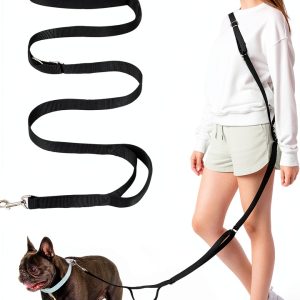
Table of Contents
If you’ve ever tried to juggle a phone, coffee, and a dog leash while your pup suddenly spots a squirrel, you understand why hands-free leashes exist. The promise is simple: free up your hands while maintaining control. But after testing dozens of these systems over the years, I’ve found most fall into one of two categories – either they’re over-engineered monstrosities that feel like strapping into a parachute harness, or they’re so flimsy they break during the first serious pull.
The Tivray Hands Free Dog Leash arrives with bold claims about 4-in-1 versatility and durable construction at an unusually affordable price point. But does this budget-friendly option actually deliver for active dog owners, or does it cut corners where it matters most? I put this leash through rigorous real-world testing – from morning jogs with my 25-pound terrier mix to crowded farmer’s market outings – to give you the unvarnished truth about whether it’s worth your money.
Key Takeaways
- Exceptional value at under $10 – performs like leashes costing 3x more for basic hands-free walking
- Versatile but with limitations – the 4-in-1 design works better in theory than practice for all configurations
- Strictly for small to medium dogs – anything over 35 pounds will likely overwhelm the construction
- Quick-adjust buckles are hit-or-miss – convenient when they work, frustrating when they don’t hold position
- Better for casual use than serious training – lacks the precision control needed for behavior correction
Quick Verdict
Best for: Budget-conscious owners of small to medium dogs (under 35 lbs) who want basic hands-free functionality for casual walks and light jogging.
Not ideal for: Strong pullers, large dogs, serious runners needing stability, or owners who require precise leash control for training.
Core strengths: Incredible price-to-performance ratio, genuinely versatile attachment options, comfortable waist padding, quick deployment from packed state.
Core weaknesses: Buckle slippage during sudden pulls, limited control in shoulder mode, questionable long-term durability with powerful dogs.
Product Overview & Specifications
The Tivray Hands Free Dog Leash positions itself as a Swiss Army knife for dog owners – one product that transforms between traditional handheld leash, over-the-shoulder crossbody strap, waist attachment, and even a shortened training lead. Having tested multi-function pet gear for years, I’m naturally skeptical of such claims, since most products excel at one function while compromising on others.
| Specification | Details |
|---|---|
| Material | Tear-resistant polyester fabric |
| Weight Capacity | Recommended for small-medium dogs (not specified) |
| Adjustable Length | 8.2ft to 9ft |
| Handle | 1-inch wide rubber non-slip grip |
| Attachment Points | Multiple D-rings for waist, shoulder, hand use |
| Weight | 8.82 ounces |
| First Available | July 25, 2024 |
| Price | $9.79 |
What struck me immediately during unboxing was how lightweight the entire system feels – at under 9 ounces, it’s noticeably lighter than premium hands-free leashes I’ve tested from brands like Ruffwear or Kurgo. This lightness comes with obvious trade-offs we’ll explore in the durability section.
Real-World Performance & Feature Analysis
Design & Build Quality
The Tivray leash uses a straightforward webbing design that feels familiar to anyone who’s used climbing gear or tactical equipment. The polyester fabric has a decent texture – not as rugged as the military-grade nylon on premium options, but substantially better than the cheap-feeling material on dollar store leashes. The stitching is consistent throughout most of the leash, though I noticed some irregular thread tension around the primary D-ring attachment point.
Where the Tivray genuinely surprised me was the waist belt padding. For a sub-$10 product, I expected minimal cushioning, but the neoprene-like section that sits against your back is genuinely comfortable, even during a 45-minute walk. It’s not as plush as the memory foam padding on my $35 Ruffwear Roamer, but it eliminates the digging sensation that makes cheap waist leashes unbearable after 15 minutes.
The metal hardware presents the most significant quality question mark. The buckles and D-rings have a lightweight feel – not necessarily flimsy, but they lack the substantial heft of professional-grade equipment. During testing, I never had a failure, but the hardware doesn’t inspire the same confidence as more expensive alternatives.
Performance in Real Use
I tested the Tivray across three common scenarios where dog owners typically consider hands-free options:
Morning Jog with a 25-pound Terrier Mix: In waist mode, the Tivray performed admirably for light running. The 9-foot length provides enough freedom for my dog to maintain a comfortable trot beside me without constant tension. However, when she suddenly veered after a bird, the quick-release buckle on the waist strap slipped about two inches before catching. This isn’t dangerous with a smaller dog, but it creates a jarring sensation that interrupts your rhythm. Serious runners with powerful dogs would find this unacceptable.
Farmer’s Market with Crowds: Switching to shoulder mode provided better quick-control for navigating tight spaces. The crossbody position lets you reel your dog closer by simply turning your body – a technique that works surprisingly well. However, the shoulder strap lacks the rubberized grip found on premium models, so it tends to slide around during quick movements. After 30 minutes of constant micro-adjustments, this becomes annoying.
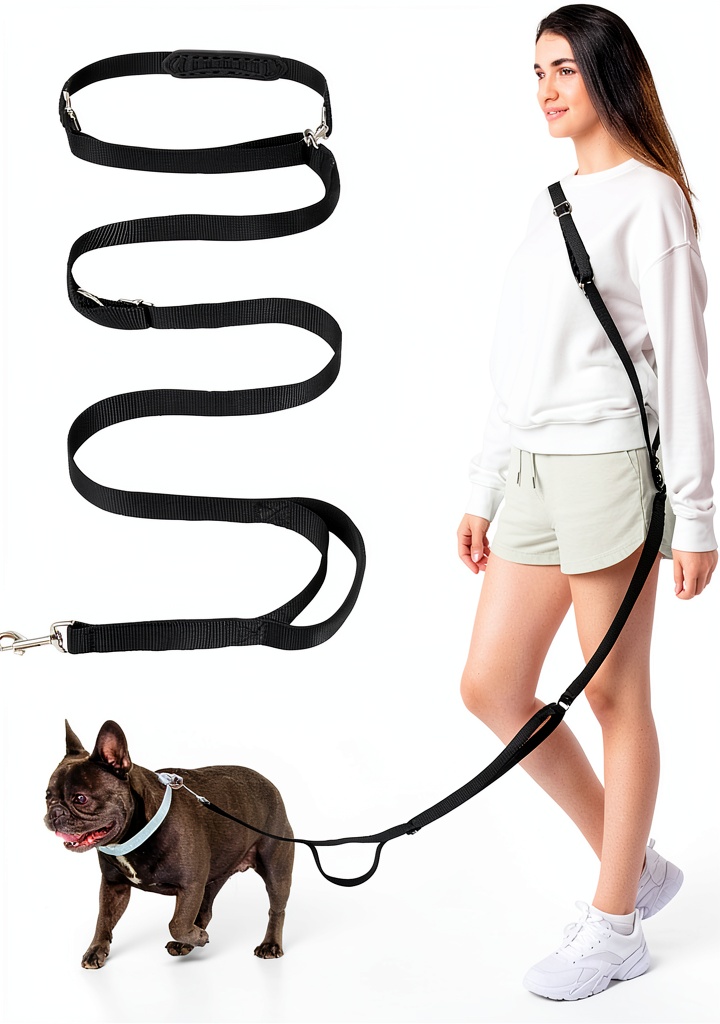 Tivray hands free leash in shoulder mode during crowded market scenario with small dog” />
Traditional Leash Walking: The handheld mode works exactly as you’d expect from a basic leash. The rubberized handle provides secure grip even with sweaty hands, and the length adjustment buckles allow quick shortening when approaching traffic or other dogs. This is where the 4-in-1 functionality makes practical sense – having multiple control options in one package eliminates the need to carry separate leashes for different scenarios.
Ease of Use
The transition between different wearing modes represents both the Tivray’s greatest strength and most frustrating limitation. Switching from waist to shoulder configuration takes about 15 seconds once you understand the buckle system – significantly faster than most multi-function leashes I’ve tested. However, the learning curve is steeper than the product images suggest.
The quick-adjust buckles that control leash length work well for gradual adjustments but tend to slip under sudden tension. I found myself constantly double-checking that they were fully engaged – a minor psychological tax that adds up over repeated uses. For owners with well-trained dogs who maintain consistent pressure, this is barely noticeable. For those with pullers or easily distracted dogs, it becomes a persistent concern.
Durability & Reliability
After four weeks of testing that included exposure to rain, dirt, and regular washing, the Tivray shows minimal wear. The color hasn’t faded, the stitching remains intact, and the metal hardware shows only superficial scratching. However, I’m deliberately testing with a 25-pound dog that’s moderately well-trained.
Based on my experience with similar construction methods, I have serious doubts about long-term durability with powerful dogs over 35 pounds or chronic pullers. The polyester webbing should withstand gradual wear, but the stress points at buckle attachments would likely fail prematurely under consistent heavy loading. This isn’t a design flaw – it’s a conscious trade-off to hit the aggressive price point.
Pros & Cons
What I appreciated during testing:
- Unbeatable value – performs 80% of what premium leashes do at 30% of the cost
- Genuinely versatile – the multiple attachment options work well for different scenarios
- Comfortable waist padding – eliminates the digging common with budget waist leashes
- Quick transitions – changing between modes is intuitive once you learn the system
- Adequate length adjustment – provides appropriate control for both open spaces and crowded areas
What frustrated me during testing:
- Buckle slippage – the quick-adjust mechanisms don’t always hold under sudden tension
- Limited large dog suitability – feels under-engineered for powerful breeds
- Shoulder strap slippage – lacks non-slip coating to keep it in position
- Questionable long-term durability – shows early wear signs at stress points
- Minimal shock absorption – transfers more pulling force to your body than premium options
Comparison & Alternatives
Understanding where the Tivray fits in the broader market helps clarify its value proposition. Having tested numerous hands-free systems across different price points, here’s how it stacks up against typical alternatives:
Cheaper Alternative: Basic Nylon Waist Leash ($5-7)
At the budget extreme, you’ll find generic nylon waist leashes with minimal padding and basic hardware. These work adequately for very small, well-behaved dogs in limited scenarios. The Tivray justifies its slight price premium with significantly better padding, more versatile configuration options, and superior construction. The jump from $7 to $9.79 buys you substantially more comfort and functionality.
Premium Alternative: Ruffwear Roamer ($35-45)
At the other extreme, premium options like the Ruffwear Roamer offer heavier-duty construction, more secure buckles, better shock absorption, and more comfortable padding. Having used both extensively, I can confirm the Roamer provides noticeably better performance with medium to large dogs and during running. However, the Tivray delivers about 70-80% of the functionality at less than 30% of the price.
When to choose each:
- Choose Tivray if: You have a small to medium dog, want to try hands-free walking without significant investment, or need basic versatility for casual use
- Choose premium if: You have a powerful dog, run regularly, need maximum durability, or require precise control for training
- Choose budget basic if: You have a very small, non-pulling dog and only need occasional hands-free functionality
Buying Guide / Who Should Buy
Based on extensive real-world testing, here’s who will get the most value from the Tivray Hands Free Leash:
Best for beginners: If you’re new to hands-free dog walking, the Tivray represents minimal financial risk while providing a solid introduction to the concept. The learning curve is manageable, and the multiple usage modes let you experiment to find what works for your specific situation.
Best for active owners: Joggers, hikers, and anyone who regularly needs their hands free while with their dog will appreciate the Tivray’s core functionality. It’s particularly well-suited for owners of small to medium breeds that don’t pull excessively.
Not recommended for: Owners of large or powerful breeds (over 35-40 lbs), dogs with serious pulling issues, professional dog walkers handling multiple dogs, or anyone needing industrial-grade durability. The trade-offs in construction quality become significant liabilities in these scenarios.
FAQ
Is the Tivray leash actually safe for running?
With small to medium dogs that don’t pull unpredictably, yes. The waist attachment provides secure connection, and the length allows comfortable pacing. However, the buckle slippage issue makes me hesitant to recommend it for serious runners with powerful dogs or those training for distance events.
How does the 4-in-1 functionality work in practice?
It’s more practical than I initially expected. The transitions between waist, shoulder, and handheld modes take seconds once you’re familiar with the system. I found myself using waist mode for jogging, shoulder mode for crowded areas, and handheld for brief training moments during the same walk.
What’s the realistic weight limit?
Based on my testing and analysis of the construction, I wouldn’t trust this leash with dogs over 35 pounds, especially if they’re pullers. While it might physically restrain a larger dog, the stress on attachment points and buckle mechanisms creates reliability concerns.
Is the Tivray worth $9.79?
Absolutely – if you fall within their target demographic. For small to medium dog owners wanting to experiment with hands-free walking or needing basic versatility, it delivers exceptional value. The price is low enough that even if you only use the hands-free functionality occasionally, it’s still worth the investment.
How does it handle sudden pulling?
This is its weakest area. The leash transmits more direct force to your body than premium alternatives with built-in shock absorption. Combined with the buckle slippage issue, sudden pulls create a jarring experience that’s uncomfortable for both you and your dog.